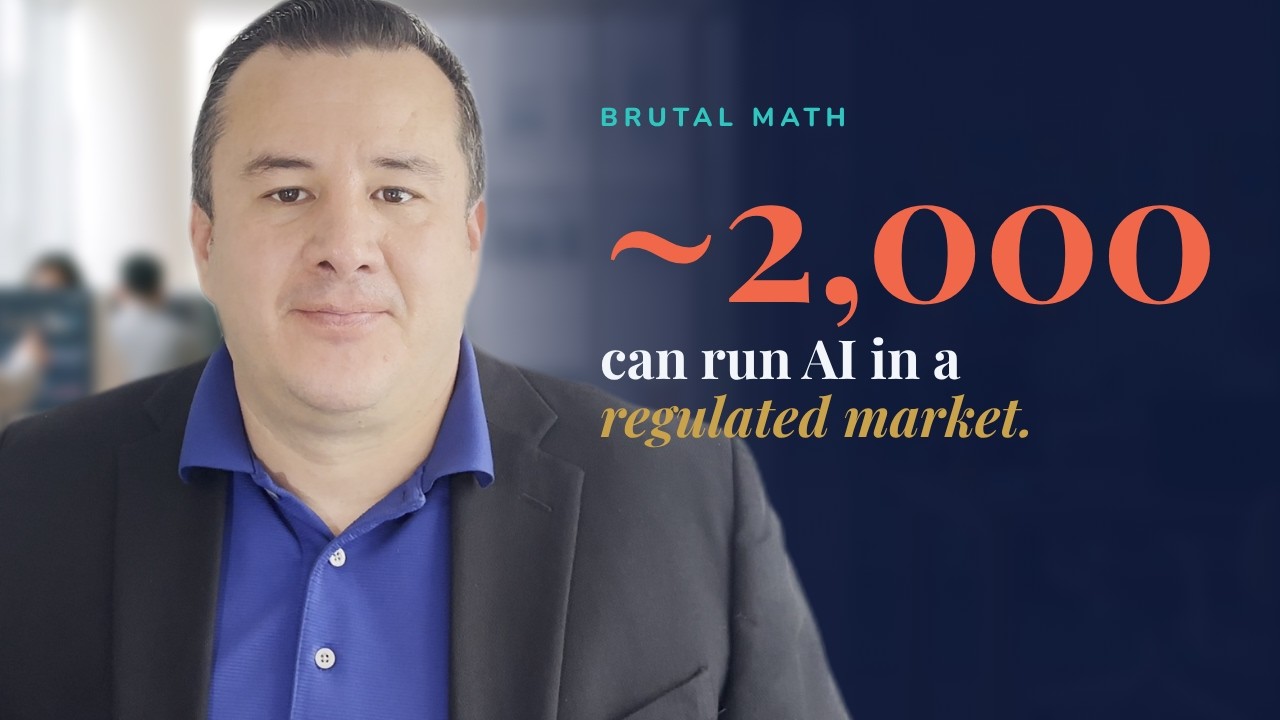
Three and a half minutes on one number: about 2,000. That's my estimate of how many people can hold regulated operations, production AI they shipped themselves, and a P&L in one head. The base and the filters are labeled as estimates and assumptions, the sources are below, and the last minute is why I'm one of them.
The CTO, the compliance officer and the office behind me are AI-generated. What I say, and the numbers, are real.
See the math, step by step, on the homepage
Transcript
Right now, venture-backed startups are shipping AI into regulated markets faster than the rules can settle. Six hard federal and EU deadlines land in the next 23 months. Underneath them, a new state AI law every two and a half days. Almost none of these companies are staffed to clear it.
In 2025, $211 billion of venture money went to AI. Half of everything raised. And the biggest checks landed where regulators are watching: $72 billion into healthcare and biotech alone. The FDA cleared 221 AI devices in 2023. In 2025, 295.
In January 2027, CMS requires prior-authorization APIs, and Colorado's rewritten AI Act takes effect. In December 2027, the EU's high-risk rules arrive. Underneath all of it, 145 state AI laws enacted in 2025 alone, and a federal task force already challenging them. One wall, you could plan for. This one moves, and it moves under companies built to ship code fast.
So the CTO hires a regulatory expert (a good one, usually). Then the trouble starts. The compliance expert doesn't speak CTO, and the CTO doesn't speak compliance. Nobody fixes that with a six-week crash course. The translation is a third skill. It takes about fifteen years to build, usually by an operator who kept ending up in the middle.
So how many people carry all three: regulated operations, production AI they actually shipped, and a P&L? Start with about 200,000 senior operations executives in regulated US industries. MIT found only 5 percent of those companies got AI into production. Of those leaders, maybe one in five can hold compliance and a P&L in one head. And that's an assumption. You land at about 2,000 people. And that's the generous math. So what stalled the other 95 percent? Integration and learning failures. That's an operations problem.
I'm Hugo Acurio. I'm one of the two thousand. Here's how I'm wired. I spot the shift early, so I see the board: idea to a production AI agent in 13 days. I connect AI, clinical, operations and revenue into one system that holds when volume grows, so I invent the system: over 100,000 patient encounters in about 18 months. And I get stalled operations moving, then build the team that keeps them moving, so I build it: over 1,700 physician engagements a month. Three moves, one operator. That's the translation.
Shipping AI into a regulated market in the next 18 months, or know a founder who is? Then let's talk.
Sources and notes
Sources: Crunchbase (Jan 7, 2026) and PitchBook for 2025 venture totals. Innolitics for FDA AI device clearances. CMS-0057-F, Colorado SB 26-189, EU Reg 2026/1744, EO 14365. MultiState for state AI law counts. MIT NANDA (2025) for AI-in-production rates. The 200,000 base is our estimate from BLS OEWS data; the 1-in-5 filter is our assumption.
The $72 billion is total 2025 venture funding into healthcare and biotech, AI and non-AI combined. The video came out on October 4, 2026, and its deadlines and counts date from then.