The short answer
I'm Hugo Acurio, and I designed and built Iris Global Ecuador's pharmacovigilance system for ARCSA's new standard, in full force since November 4, 2026. It's a regional platform under Iris LLC. Ecuador went live first, and Iris Mexico is next.
It runs on the ERP the company already uses. A report comes in through any of four channels, becomes a ticket the moment it lands, and turns into a regulated case with its own ID and its own regulatory clock. Seven stages carry it to the regulator, two human signatures gate the release, and seven automated escalations keep anything from sitting. The screens in the video and further down are the real system, with test data and names blurred.
Watch the 2-minute version
The design came first. I wrote it up in October, before go-live, and that piece is here →
The board I saw
ARCSA published its substitute pharmacovigilance standard in February 2026. It names a responsible pharmacovigilance officer who must sign every submission, specifies the causality algorithms allowed, requires duplicate detection as a system function, and moves reporting onto WHO's e-Reporting platform. Ecuador isn't moving alone.
| Country | The rule | What it asks for |
|---|---|---|
| Ecuador | ARCSA, Resolución ARCSA-DE-2025-052-DASP. In full force since November 4, 2026. | A named pharmacovigilance officer signs every submission. Duplicate detection as a system function. Reporting through WHO's e-Reporting. |
| Brazil | ANVISA, RDC 967/2025. In force since March 2026. | VigiMed, E2B(R3), MedDRA and WHODrug, all mandatory. |
| Mexico | COFEPRIS | 82,993 notifications received in 2025. Iris Mexico is next on this platform. |
The 15 and 30 day clocks (serious and non-serious cases) run from the moment any employee becomes aware of the event (a sales rep, a phone assistant, whoever reads the comment on social media), not from when a case is opened. A system that starts the clock at case creation is already late.
Most AI-in-pharmacovigilance pitches cannot survive an auditor. A language model is probabilistic, and a regulator asking how a case was coded wants a reproducible answer. Compliance is a systems problem, not a knowledge problem: I cannot audit how a model thinks any more than I can audit how a person thinks, so the audit happens outside the model, in the middleware. Every model call gets an input hash, a version, a confidence score, and a human on the transmission trigger.
The clock starts before the case does
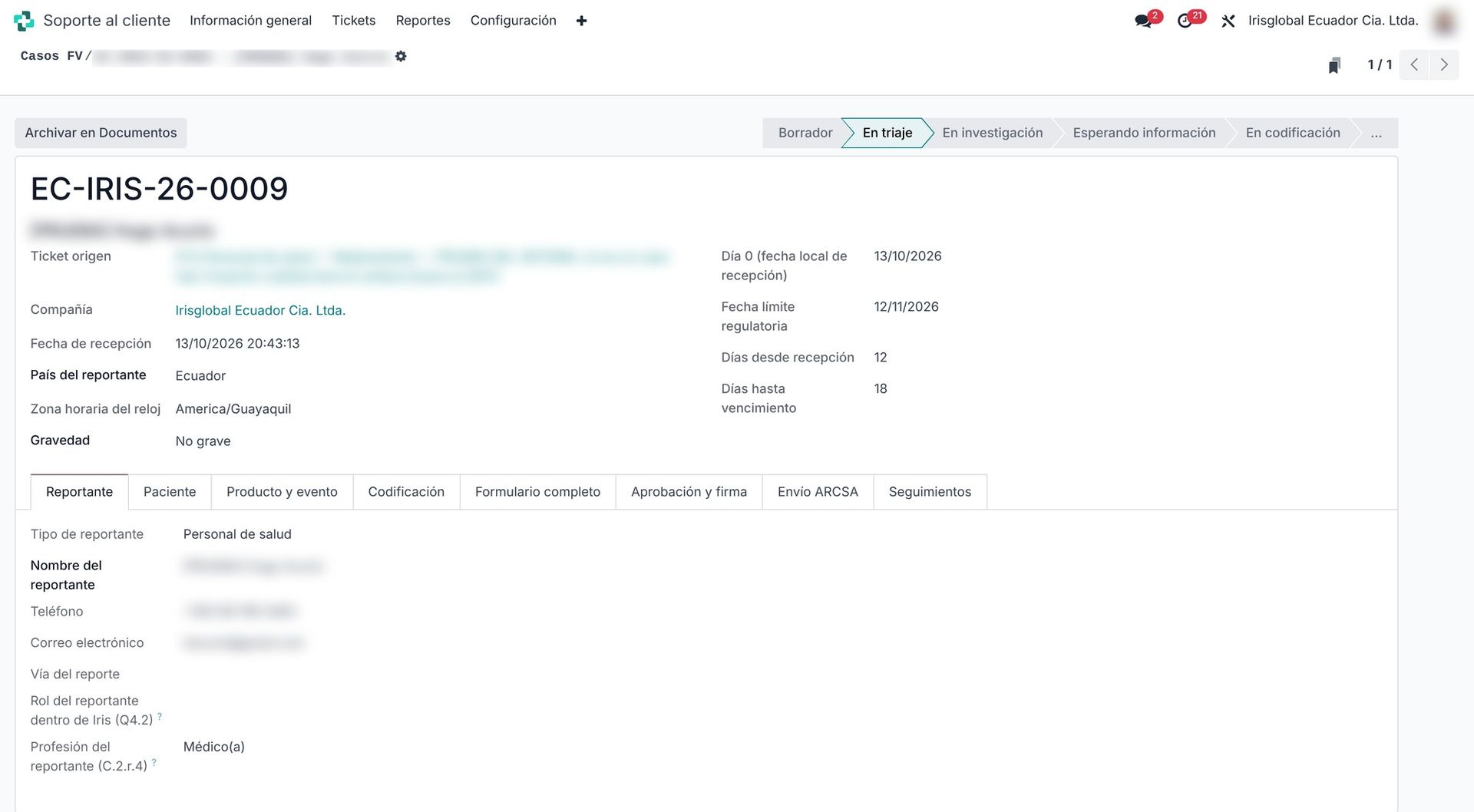
So the system stamps day 0 when the report is received, before anyone opens a case, counts in Ecuador time, and puts the days left on every case and every kanban card. The color changes as the deadline gets close. Nobody has to remember to check.
- 1Day 0. The report is received and the clock starts. The case has to reach triage within 6 business hours.
- 2Day 8. Causality still not done: the causality escalation fires.
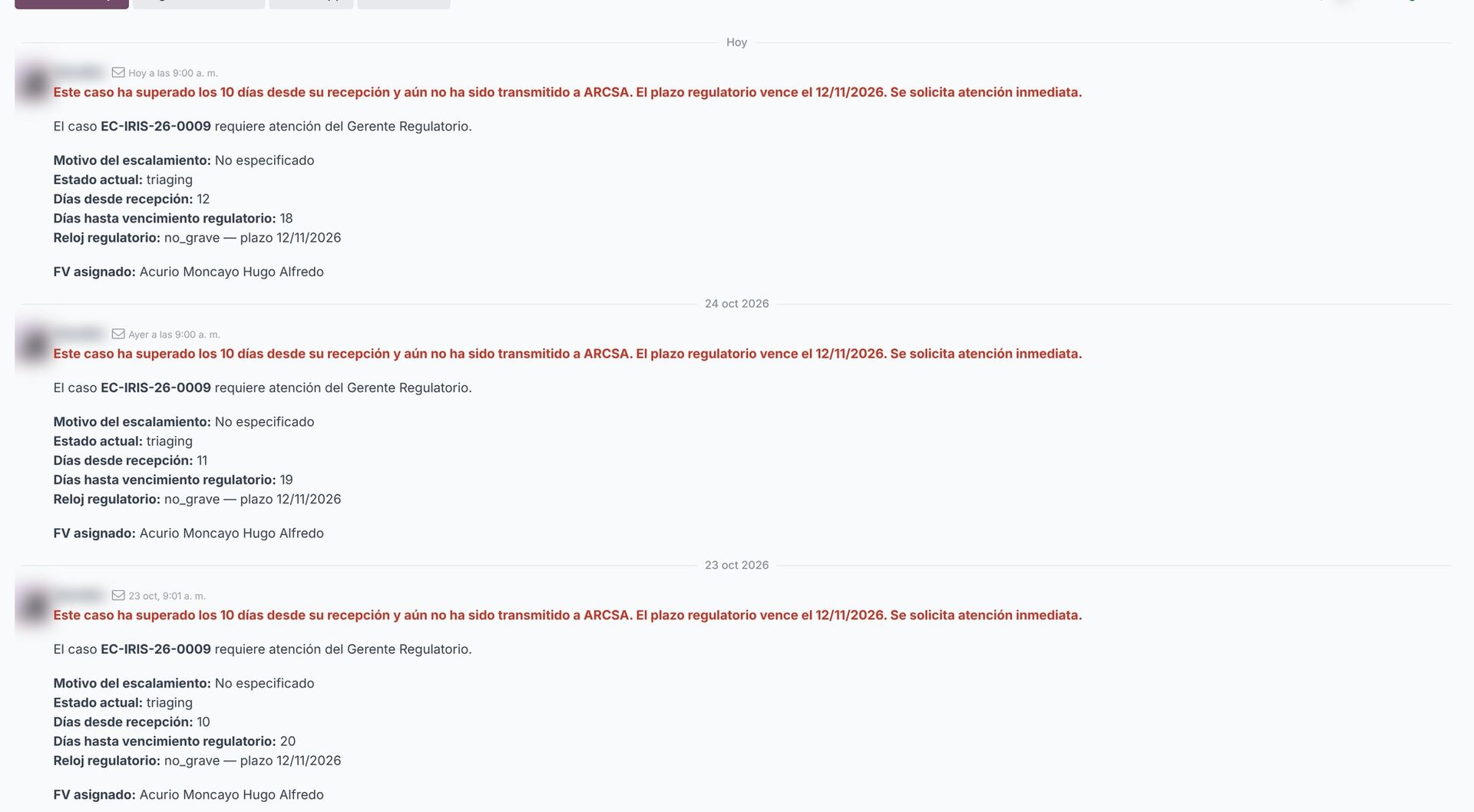
- 3Day 10 and not sent to ARCSA: both managers get the alarm, every morning until someone acts.
The deadline depends on seriousness: 15 days for a serious case, 30 for a non-serious one. That's why seriousness gets called at triage, early, by a person. Calling it late eats the clock you need most.
The path of a case
From the first message to the regulator's acknowledgment, this is what happens, and what happens on its own.
Seven stages, two human gates
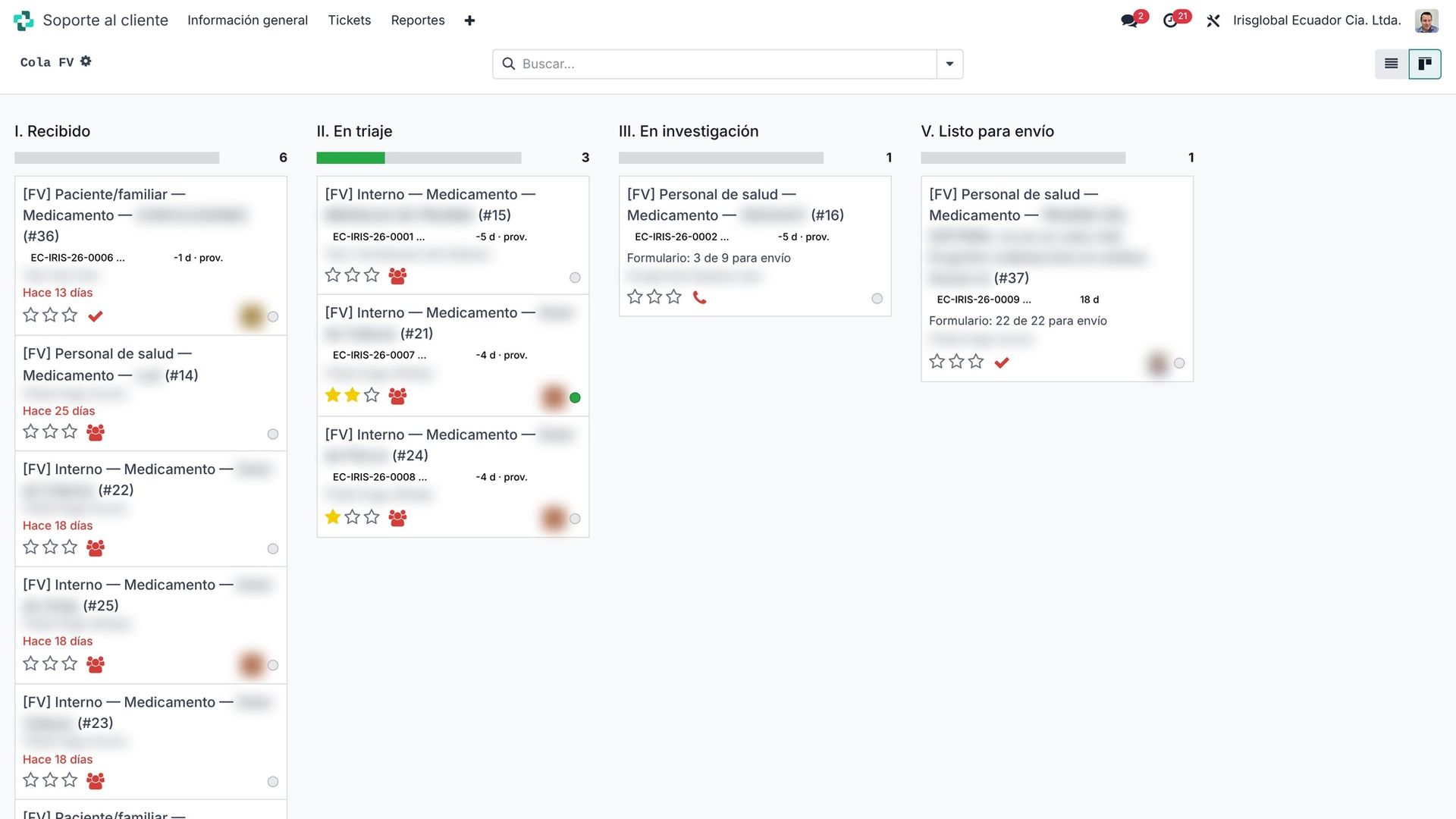
The kanban is the work queue. The first four stages run with the team. Stages V and VI sit behind a named person's signature.
The officer-only rule is enforced by the system itself, so nobody has to remember it. Closed cases can't be edited. A follow-up opens a new version of the same case under the same worldwide ID, so the original stays exactly as it was submitted.
Seven escalations, so nothing sits
The system watches the work as well as the deadline. These run on their own, on Ecuador business hours.
| What it watches | When it fires | Checked |
|---|---|---|
| Reporter scheduling | No call booked with the reporter | Daily |
| Daily follow-ups | The day's follow-up isn't done | Daily |
| Lab results | Results still pending | Every 12 hours |
| Causality | Not done 8 days after receipt | Daily |
| The day-10 cascade | Day 10 and not sent to ARCSA: both managers are alerted | Every morning |
| Manager approval | Waiting more than 24 hours | Every 4 hours |
| Officer's submission window | Waiting more than 24 hours | Every 4 hours |
The day-10 cascade repeats every morning until someone acts. The third screen below is exactly that, three mornings in a row.
One record, in the regulator's format
The case follows the structure of ICH E2B(R3), the format regulators use to exchange safety reports. Each section is its own part of the case, so the XML comes out of the record instead of being retyped into a portal.
Every kanban card shows how many required fields are complete, so the team sees 22 of 22, ready to send, before anyone has to ask. The XML is generated from the case and checked against the schema before the upload. The MedDRA version used is stored with the case, so a disputed code can be reproduced exactly as it was sent.
Every change to a section of the case leaves a note with who and when. The audit trail, the compliance evidence pack, the inspection response and data-subject requests all come from that one record, viewed differently. Today the record is the ERP's own tracking log. The next version chains each entry to the one before it, so any edit would show.
What is running today
The case-handling spine runs on the production instance, built to the workflow our pharmacovigilance lead designed. Her rule was simple and non-negotiable: the regulatory clock does not stop. The days remaining render on every case and every kanban card, including while the team waits on a reporter or a lab result.
Role-gated access covers four groups (analyst, pharmacovigilance officer, regulatory manager, general manager), with case data visible only to them and no administrator back door. Reporter data is protected: consent captured at intake, phone reports typed straight into the ticket with no recordings kept, and a published privacy section built for the standard's data-protection article.
It went live on November 4, 2026, after end-to-end testing on the production instance with test records, with MedDRA and WHODrug licensed and the ARCSA upload path settled. The screens below come from that testing, names blurred.
The next layer: AI with a narrow job
The AI sits on top of the native automation instead of replacing it, and it comes after go-live. Each piece takes follow-up work that lands on the analyst today and closes it in the background, ranked by how much human time it gives back.
- Prepare: schedule, draft, gather
- Suggest, with a confidence score
- Follow up across channels
- Log every action next to the human call
- Decide seriousness
- Choose the causality result
- Sign for the officer
- Send anything to the regulator
Seriousness, causality, the officer's signature and the upload to ARCSA stay as traceable human decisions by design. An inspector won't accept "the model decided" as an answer, so the design never asks one to.
The result
Seven stages, with two human gates before submission. Four role groups, access by role, no back door. Seven automated escalations, on Ecuador business hours. One record of every action, which is also the audit trail and the evidence pack.
I presented this architecture at Seton Hall Law's Latin America Healthcare Compliance program in Bogotá in September 2026, to compliance officers, regulatory counsel and pharma in-house teams from across the region, who read it as an immediate risk rather than a topic.
It's built to travel. A second company gets its own scoped space on the same system (setup, not a rebuild). The evidence pack is a query, so one log answers any regulator: ARCSA, ANVISA or COFEPRIS. And it covers a segment others skip: Spanish-language regulated pharma, on the same clock everywhere, with no global vendor built for it.
What this proves
Put the audit outside the model. Log every call with input hash, version, confidence and the human decision, so the model can change without the record changing.
Build the regulator's clock into the record. Start it where the law starts it, show it where people work, and escalate before the deadline instead of reporting after it.
Let the model suggest, keep a person on the trigger. Map which steps a regulator cares about and keep every one of them with a named human role.
See the board, invent the system, build it.
How the AI layer stays auditable: AI regulatory compliance for healthcare and pharma operations.
The regulatory side, country by country: AI in pharmacovigilance in Latin America.