The short answer
A startup should bring in a COO, fractional or not, the moment execution gets cheap and judgment becomes the scarce resource, which now happens earlier than most founders expect. Gartner expects more than 40% of agentic AI projects to be canceled by 2027, citing escalating costs, unclear business value, and inadequate risk controls. My read (I'm Hugo Acurio, 15+ years running regulated operations): those are symptoms of nobody owning the whole board, and that judgment (not administration) is what a fractional COO brings in now, often before a company can justify a full-time hire.
Until recently, the advice made sense: a small company can't afford a COO. In the early days, the founder is the COO. You're close enough to everything that the operational judgment lives in one head (yours, the CEO). A senior operator to run the machine was something you earned later, once there was enough machine to justify the cost. Hire too early and you were paying for overhead you didn't need yet.
That logic held for decades. It doesn't anymore.
AI collapsed the cost of doing, not because COOs got cheaper. And when doing gets cheap, the thing that's scarce changes.
The bottleneck moved. Think about what used to be slow and expensive for a small company: building the product, standing up a GTM motion, producing the content, running the analysis, shipping the next iteration. All of it took people, time, and money you didn't have. Execution was the constraint, so the game was simple. More hands, more capital, do more.
AI broke that. A small team can now ship product, launch campaigns, produce content, and run analysis at a speed and cost that needed a full department three years ago. The numbers are blunt: AI is cutting early-stage build and operating costs (Microsoft's Amanda Silver, CoreAI), and small teams now ship what once took a full department (Silver predicts “higher-valuation startups with fewer people at the helm.” The world is on track to spend $2.5 trillion on AI this year (Gartner)).
Execution gets cheaper and faster every quarter now, no longer the bottleneck. Which raises the only question that now matters: when doing is easy, what's scarce? Judgment. What to build, and in what order. Which GTM motion to run, and when to kill it. What to measure, now that "output per person" means something completely different. How fast to iterate, and on what. The constraint stopped being can we execute and became do we know what to execute, and how to run it.
That's an operating-judgment problem, not one you solve with more hands/tokens/budget or a bigger raise.This calls for a different kind of COO. Here's where the instinct misfires. When most people picture a COO, they picture an administrator (the person who writes the SOPs, builds the dashboards, tracks the KPIs, squeezes cost and tightens productivity). That role exists. And AI is automating big parts of it: the documentation, the reporting, the routine optimization.
That is not the COO this moment calls for. When every function, product, GTM, marketing, finance, is iterating fast and feeding off the others, the hard part is seeing how they connect, in motion, and translating that into the next move, not running any single one of them. The marketing experiment that just shifted your unit economics has implications for pricing, which changes your GTM, which changes what the product team should build this sprint. Those threads used to move quarterly. Now they move in real time. Someone must hold all of them at once and convert the pattern into a decision (before the window closes).
That's synthesis, not administration. And it's the scarce skill precisely because it's the one AI doesn't replace. AI makes each function faster, which only multiplies the number of moving parts a human has to connect. The faster the pieces move, the more valuable the person who can see across all of them becomes.
This isn't only happening to operators. The research mapping software engineering's 2030 roadmap projects the same shift for developers. They stop being code writers and become orchestrators of AI systems, the value moving from doing the task to directing it (ACM, A 2030 Roadmap for Software Engineering).
But here's the reflex worth catching. As execution collapses, the instinct is to hand the orchestration to the people closest to it (the engineers). They understand the machine better than anyone. That's exactly why it's the wrong default. Running the technical system and connecting that system to the customer, the P&L, and the vision are different skills. The best orchestrator of code is still orchestrating code. The scarce role is the one who can hold product, GTM, finance, and people in view at once and translate across them in real time, not the person who masters one function deeply.
You can watch this play out in healthcare right now. The smartest conversation in the field has landed on an insight: bring clinical expertise into product decisions early, before the workflow friction gets baked in. That's correct. It's still one bridge. Clinical-to-product fluency gets you a tool clinicians tolerate instead of ignoring. It does not, on its own, get you the human-in-the-loop supervision the technology needs, the operational flow it must fit, the iteration loop that improves it, the unit economics that keep it alive, or the regulatory line it can't cross. Each of those is another connection. The field spotted that a translator beats a specialist, then quietly narrowed "translator" to the one seam it could see. The deployments that survive need someone holding all of them at once.
That seat is connected to every single function. Most org charts don't have a name for it yet. That's the seat this moment is creating. It's what a COO now must be: the synthesizer who connects every fast-moving piece and turns it into action, fast enough to keep pace with the iteration, not the administrator who optimizes a function.
The competitive math nobody's pricing in. This is why it stopped being a nice-to-have. A company with that judgment out-cycles its competitors (faster growth is just the side effect). A competitor running AI with discipline changes their GTM mid-quarter when the data turns. They redefine their KPIs around speed-to-iteration and output-per-person, because the old headcount-based metrics quietly stopped meaning anything. They run more experiments per dollar. They kill the losers faster. Every loop they close, they learn something you don't.
Most companies are getting this wrong, which is exactly where the opening is. Only about 5% of enterprise AI pilots deliver measurable bottom-line impact (MIT NANDA, 2025). In a Gartner survey of 506 CIOs, 72% said their organizations are breaking even or losing money on AI. Gartner expects more than 40% of agentic AI projects to be canceled by 2027, citing escalating costs, unclear business value, and inadequate risk controls. My read: those are symptoms of nobody connecting the moving parts. The tools are now abundant. The discipline to aim them is not.
So the small company that decides it "can't afford a COO" is choosing to get out-iterated by a competitor who didn't skip the judgment, not to save money. The dynamics of competition, go-to-market, and how you define winning are all shifting at the same time (and operating blind through that shift is the most expensive line on the board).
How to know you've hit the wall. This is abstract until you see it in your own company. So here are the signals. Recognize more than two or three, and it's no longer a someday question:
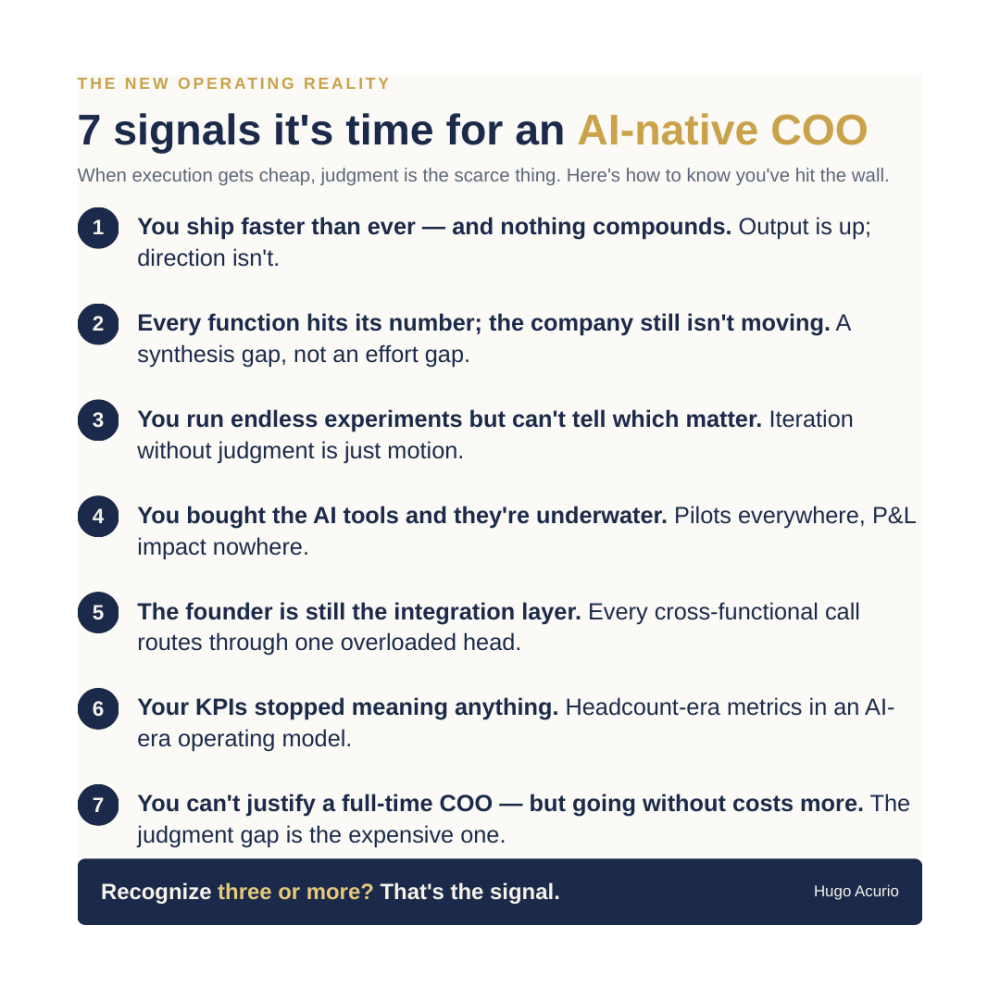
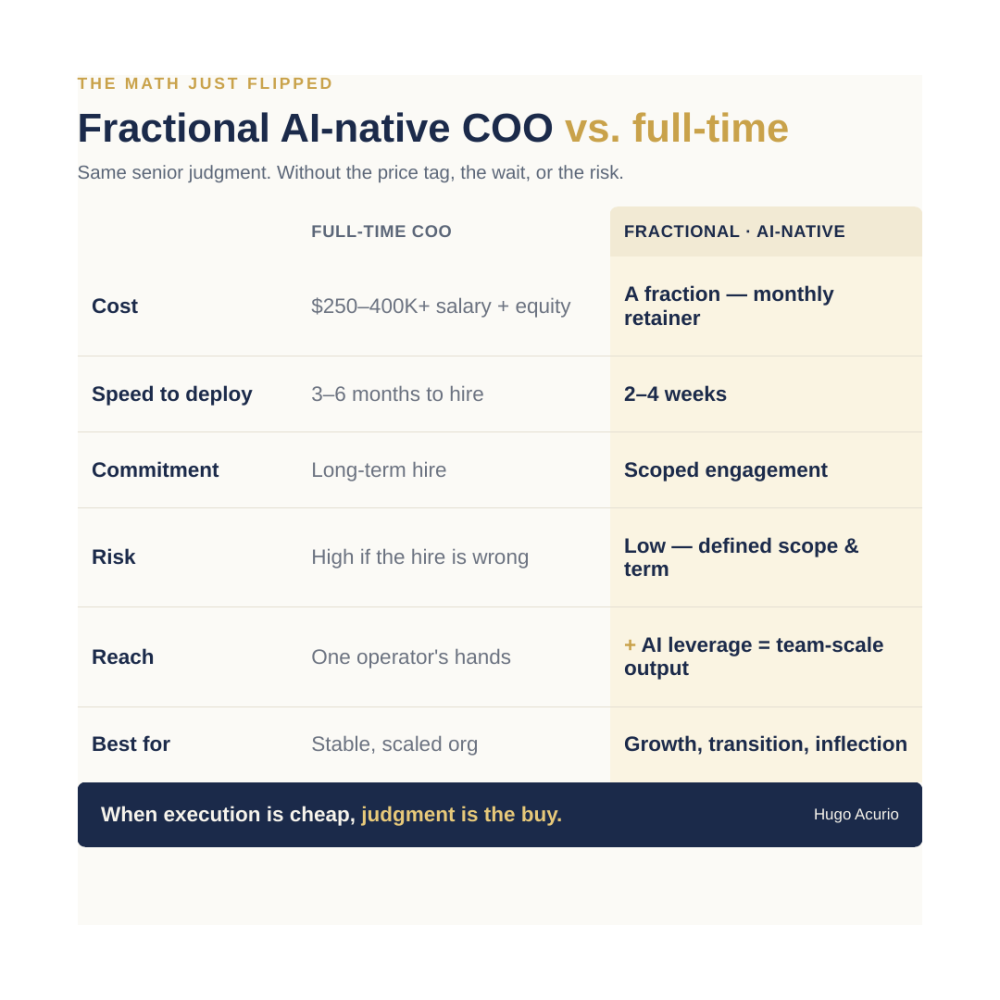
None of those is a tooling problem. Every one is a judgment problem. They're what the wall looks like from the inside. And now the cost objection dissolves on its own. Notice what never entered the argument: a $300K full-time executive. Because that's no longer the only way to buy operating judgment. The same leverage that changed everything else changed this too. Senior, AI-native operating judgment (brought in fractionally and amplified by the very tools driving the shift) means a small company can get the whole-board view without the full-time price tag. The thing you were certain you couldn't afford is now within reach.
Which inverts the whole question. It was never "can we afford a COO?" The question that matters (the one the market is now asking on your behalf) is: can you afford to operate blind while the rules of competition change underneath you? For most small companies, the honest answer is no.
The old belief was right for its time. The math just flipped. The companies that figure that out early (the ones who buy judgment before they think they need it) are the ones still standing when the cheap-execution era finishes sorting the disciplined from the merely busy.
You don't earn the operator later. In this market, the operator is how you get there.
I work with scale-ups and small companies in exactly this transition. I bring senior, AI-native operating judgment, so you get the whole-board view.
Sources: 1. MIT Project NANDA, “The GenAI Divide: State of AI in Business 2025.” Found that 95% of enterprise GenAI pilots delivered no measurable P&L impact; only ~5% captured significant value. 2. Gartner, “Worldwide AI Spending Will Total $2.5 Trillion in 2026” (Jan 15, 2026). $2.52T forecast, +44% year-over-year.gartner.com/en/newsroom/press-releases/2026-1-15-gartner-says-worldwide-ai-spending-will-total-2-point-5-trillion-dollars-in-2026 3. Gartner, “Over 40% of Agentic AI Projects Will Be Canceled by End of 2027” (June 25, 2025), citing escalating costs, unclear business value, and inadequate risk controls. gartner.com/en/newsroom/press-releases/2025-06-25-gartner-predicts-over-40-percent-of-agentic-ai-projects-will-be-canceled-by-end-of-2027 4. Gartner, May 2025 survey of 506 CIOs and technology leaders (reported Oct 20, 2025): 72% reported their organizations are breaking even or losing money on their AI investments. 5. Amanda Silver, Corporate VP, Microsoft CoreAI (Oct 2025 interview): AI agents reducing early-stage startup costs by roughly 70–80%, enabling “higher-valuation startups with fewer people at the helm.” 6. ACM Transactions on Software Engineering and Methodology, “A 2030 Roadmap for Software Engineering” (2025): developers shifting from writing code to orchestrating AI systems.dl.acm.org/doi/full/10.1145/3731559
Hiring for AI leadership? See what to look for in a Fractional Chief AI Officer.