I have spent fifteen years running operations in consumer health, telehealth, and pharma. The most useful number I ever watched was never in a monthly report. It was the signal that moved before the report did.
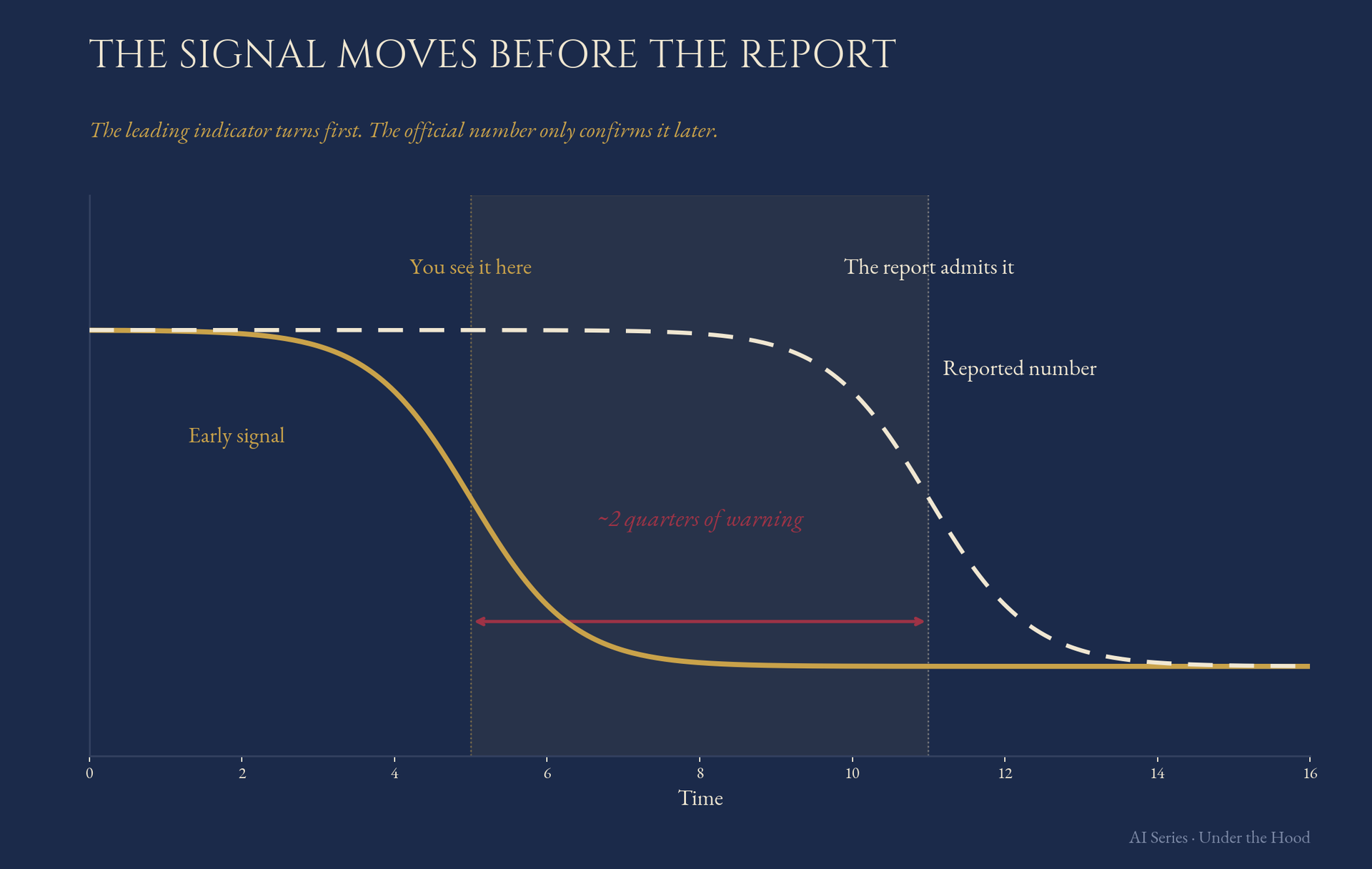
Every operator knows the feeling. The dashboard still looks clean, but the early signals (the demand mix shifting, the questions customers start asking, the small behaviors that surface weeks before they reach revenue) are already telling you where this is heading. By the time the official number confirms it, you are two quarters late to a decision you could have made in real time.
That gap (between the signal that leads and the number that lags) is the seam I want to talk about. But this piece is not really about early signals. Those are the doorway. What is on the other side is a bigger claim about how companies win in the AI era. Here it is in one line: when AI and platforms stop being a moat, the winner becomes whoever is best at compounding micro-adjustments.
When everyone rents the same brain
We are entering a phase where raw technology, software, and AI models are commoditized. When everyone can rent the same foundational intelligence for the price of an API call, a one-time product leap stops protecting you (someone clones the capability by next quarter).
Bill McDermott, CEO of ServiceNow, put the labor side of this plainly on Bloomberg TV last year: "We're slowing down the hiring in jobs that are, quite frankly, soul-crushing jobs." The operational signal underneath the headline is the part that matters. Anything purely mechanical, any task a machine can ingest, stops being where humans add value.
So the advantage moves. It comes off the product leap and lands on organizational velocity: the ability to adjust, continuously and faster than the competition, to conditions as they actually are. Leading indicators (the canary in the coal mine) are one input into that. Just one. There are millions of others, and most companies are not wired to use a single one of them in real time.
The F1 paradigm: from structural leaps to active aero
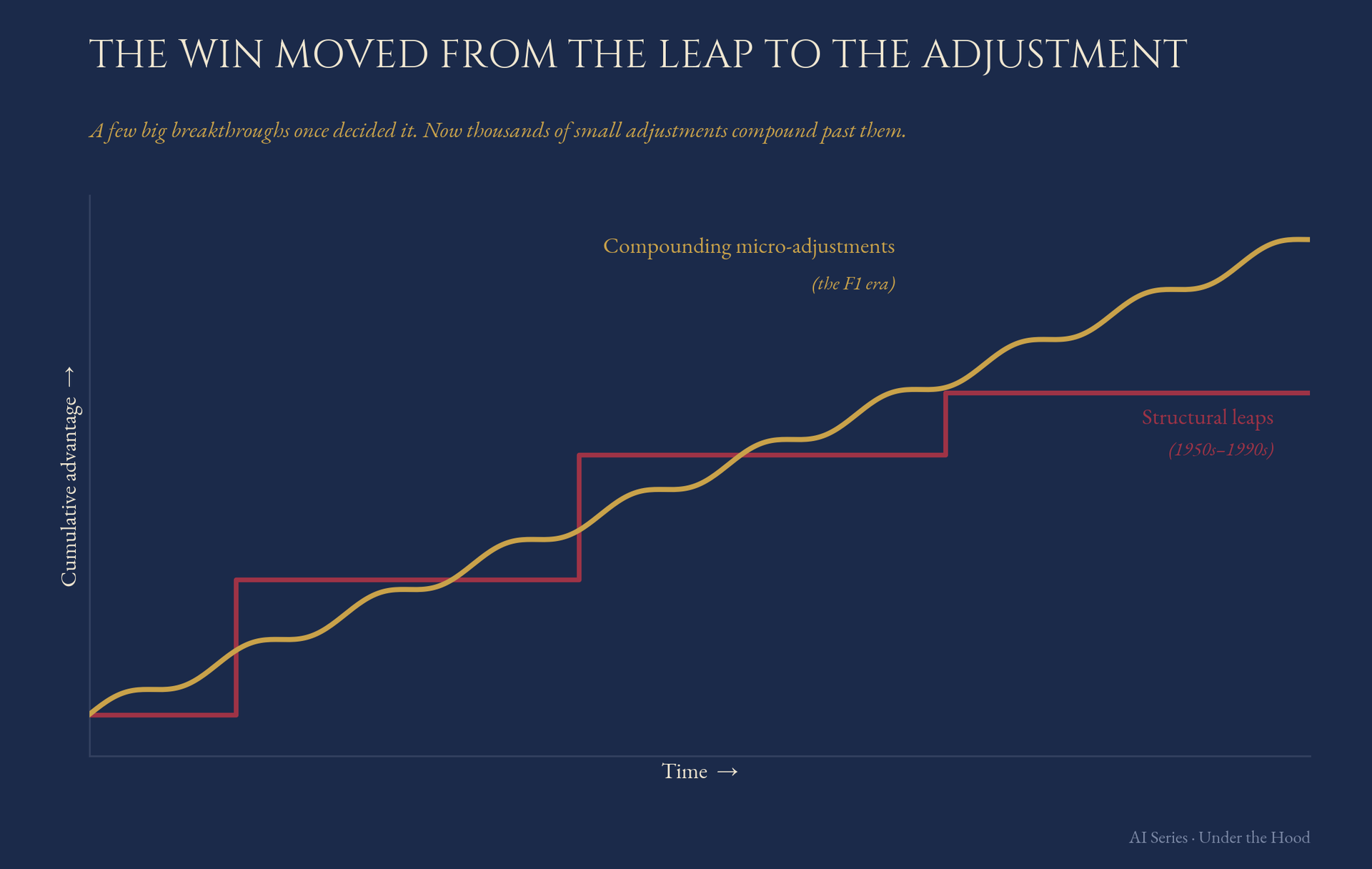
Formula 1 is the cleanest picture of where this goes. From the 1950s to the 1990s, teams won with structural breakthroughs (disc brakes, moving the engine behind the driver, the carbon-fiber monocoque). Big leaps, big gaps. Then the regulations tightened and flattened the field. Nobody gets to reinvent the car anymore.
So how do teams win now? They compound milliseconds across a single lap. Active aerodynamics (wings and flaps that adjust in real time to speed, cornering angle, and wind resistance) lets the car re-optimize itself hundreds of times a lap. The gains are tiny and constant, and over a race they decide the podium.
Enterprise business is at its F1 moment. When you and your competitor both rent the same models, the app stops being the edge. The edge becomes how fast you adjust, lap after lap, to the track as it actually is.
The frontier already proves the point (it just proves a fragment of it)
Let me be precise here, because the readers I most want will notice if I am not. Feeding external signals into operations is not virgin territory, but the layering matters. Platforms like Blue Yonder and o9 are not ERPs. They are AI-powered supply-chain platforms that bolt on top of the ERP (Oracle, SAP), which stays the system of record. And a system of record looks backward by design (it tells you, cleanly and reliably, what already happened). The forward-looking part (demand sensing that reads weather, social, regional search tendencies, and macro signals and can pre-adjust inventory, even pricing) lives in that thin platform layer on top. Done right, it works. It is also doing a fraction of the job.
Because look at what that frontier actually is. A forward-looking sliver, bolted onto one function (supply chain), riding on top of a backward-looking record system, sold at the half-million-dollar tier. The thesis here is bigger by an order of magnitude. Not one signal feeding one department. The whole company run as a compounding-adjustment engine, across every function, drawing on a signal space we have barely started to map. The leaders are doing this in one corner of the building. The paradigm is doing it in all of them.
The shape of the signal space
Picture the inputs in four layers (this is the map, not the territory, and the point is the breadth, not any single wire):
- Intent (demand friction). What the market is thinking weeks before it opens its wallet. Search-intent shifts (tracking "diy appliance repair" climbing against "appliance repair service," a quiet wallet squeeze). Regional job-posting velocity. Semantic shifts across forums and reviews.
- Infrastructure (logistics friction). The physical bottlenecks forming upstream. AIS transponder data from cargo ships at choke points (delays you can see weeks before a component lands). Freight spot-rate spikes. Weather anomalies against historical norms.
- Ecosystem (competitive and margin friction). What your suppliers and rivals are doing before they announce it. A jump in a competitor's ad-pixel activity (an imminent push you can price against). Shipment-timing variance from an upstream supplier signaling a strain they have not disclosed.
- Macro (capital-velocity friction). Where money is actually moving. Alternative-credit activity, pawn-shop and short-term-lending frequency, regional utility-grid strain as a proxy for industrial volume.
One caveat worth putting in writing: some of these are target-state, not a plug-and-play API today (real-time consumer-credit inquiry data by ZIP, for instance, carries genuine access and regulatory friction). Name them as the direction of travel, and you keep your credibility.
One signal, fully walked (because a machine should not guess)
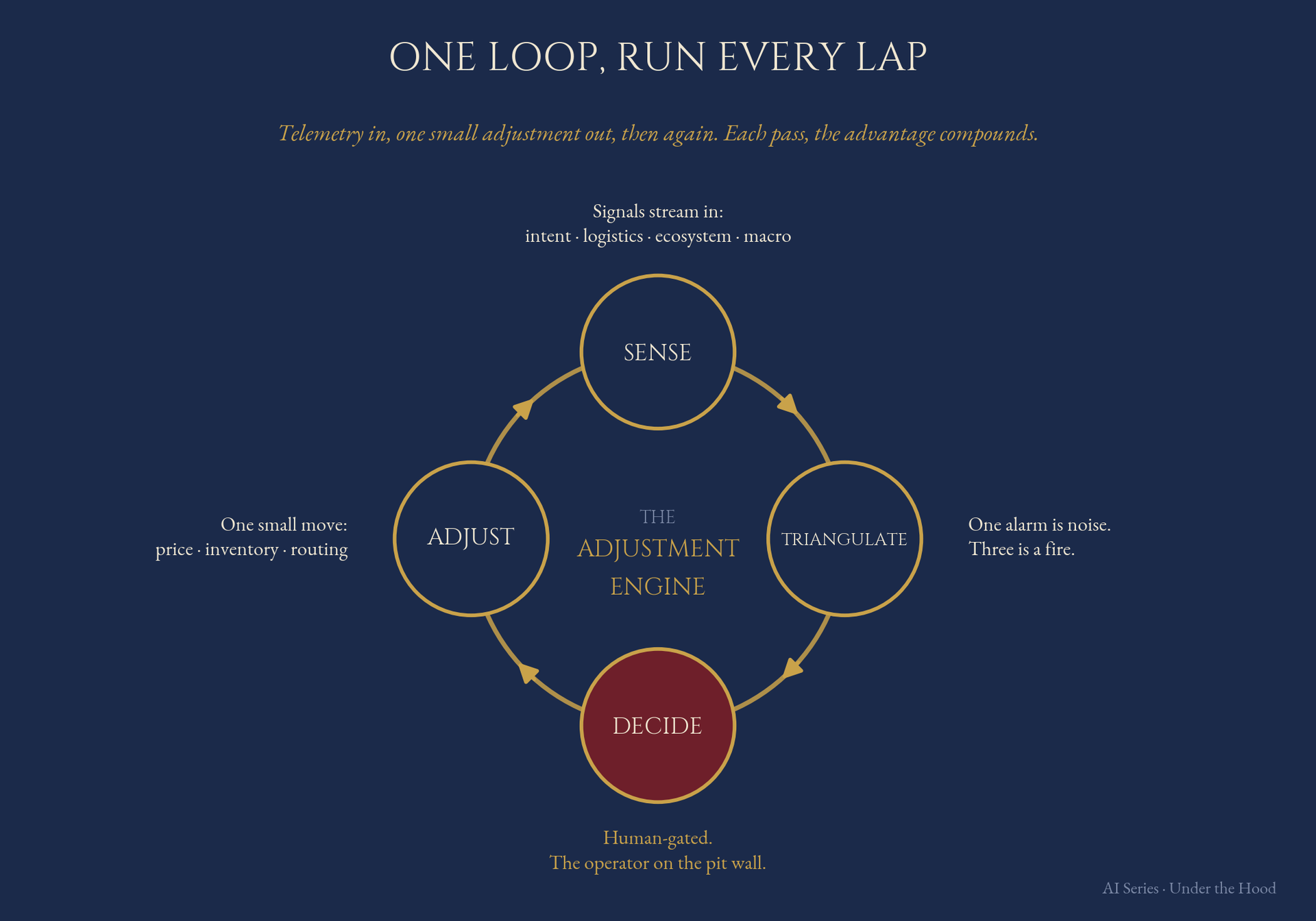
Breadth earns attention. A concrete example earns trust. So take the canary we started with and walk it all the way to an operational action. The engine treats the market like a smoke detector. One sensor is a false alarm. Three sensors going off at once is a fire.
- The spark (high-frequency, high-noise). A 25% surge in localized searches for "pawn loans" and "emergency cash" across a cluster of ZIP codes.
- The context (medium-frequency, high-context). The system checks unemployment-claims data and news scrapers for that county, and finds a 1.8% claims spike alongside a headline about a plant closing there.
- The financial reality (instant). Alternative-credit feeds show a 15% jump in short-term loan inquiries in that same demographic.
Three alarms. The engine diagnoses a regional liquidity crunch (weeks before it would surface in a sales report) and recommends a pre-emptive move: mark down mid-tier inventory in those stores, shift local spend toward private-label alternatives, clear the shelf before the wallet closes.
Notice the word recommends. This is the guardrail, and it is not optional. A signal like search is noisy (the research is blunt that it sharpens your read on uncertainty more than it nails a point forecast). You do not hardwire a probabilistic whisper straight to the cash register, because one false positive there bleeds margin. The rule I run every AI system by holds here: AI should not guess. The signal is a scored input into a human-gated decision, behind a confirmation gate, with an audit trail. Fast, and never unsupervised. This is the same path the serious operators already walk, by the way: run it in shadow mode, let a human approve, and only then let anything move on its own.
The CFO's version: why small and constant beats big and rare
Operators go hunting for the one lever that jumps 20%. The compounding engine wins somewhere less glamorous, on the aggregation of marginal gains.
Keep the math honest and it is still striking. Take a mid-market retailer at $100M in revenue and a thin 10% net margin ($10M in profit). Now stack small, independent improvements across levers that talk to each other: throttle production a week ahead of a predicted dip (less capital trapped in inventory), move on price before a local softening (a point of share off a slower competitor), route logistics around a disruption you saw coming. None of these is heroic on its own. But recovered margin points stack, and on a thin base they swing the bottom line hard. Pull a point and a half of net margin back, and that $10M becomes $11.5M. A 15% lift in profit, with no new product, no new headcount, no breakthrough. Just a company that adjusts before the others notice there was anything to adjust to
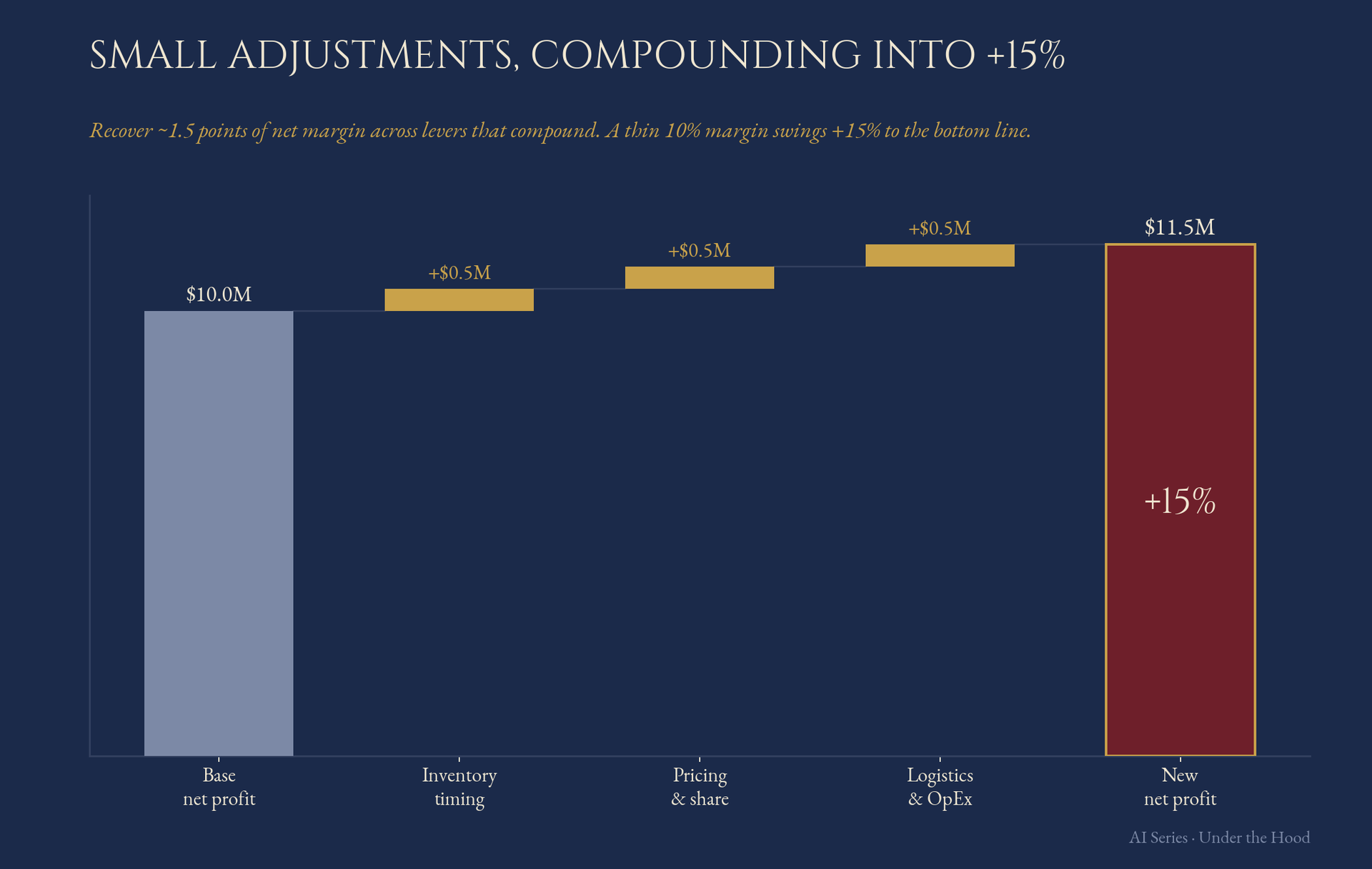
That is the compounding. It does not announce itself in any single quarter. It shows up as a business that is quietly, structurally harder to beat.
The final turn: the telemetry is commodity, the operator is everything
There is a trap sitting inside this thesis, and it is worth naming. If you build the adjustment engine, you win a window. But technology has a relentless pull toward ubiquity. The code gets open-sourced, the APIs get standardized, and eventually every team on the grid has the same real-time telemetry. Once everyone has the sensors, the sensors stop being an edge.
So where does the winning margin go? Back to the beginning. Back to the operator. F1 teams do not win because there are sensors on the car. They win on the pit wall, where a human reads the whole board, holds a hundred variables at once, and makes the judgment call the instant the rain starts to fall. They win because of the person in the seat.
That is the irony of the AI era. Automating the mechanical bottleneck does not retire human judgment. It hyper-indexes on it. When the machine can generate the language and reconfigure the supply chain on its own, the value of raw execution falls toward zero, and what is left standing is the thing the machine cannot copy: conception, taste, systemic intuition, judgment under pressure.
Automating the mechanical work is how a company finally finds out which of its operators can actually drive. If this is a seam you are watching in your own operation, I would like to compare notes. That is the whole point of the pit wall. Nobody reads the board alone.
Sources
- Bill McDermott, Chairman and CEO of ServiceNow, on hiring and automation. Bloomberg Television, July 2025.
- Blue Yonder, Demand Sensing and Dynamic Demand Response (ingesting external real-time signals such as weather, social, and macro, and autonomously adjusting inventory and pricing). blueyonder.com.
- o9 Solutions, demand planning that connects real-time demand signals directly to the financial P&L.o9solutions.com.
- Hyunyoung Choi and Hal Varian, "Predicting the Present with Google Trends." Economic Record, 2012 (foundational work on search data as a leading, or nowcasting, signal).
- Dave Brailsford and British Cycling, the "aggregation of marginal gains." See Harvard Business Review, "How 1% Performance Improvements Led to Olympic Gold," 2015.
Hugo Acurio Healthcare Operations Leader · AI-Native Operations · Fractional or Full-Time
hugoacurio.com · linkedin.com/in/hugoacurio · [email protected]
AI Series · Under the Hood · 1 of 5 The technology is the vehicle. The question that decides the race is who is in the driver's seat.