The board I saw
A founder-led pharma and diagnostics business has a particular problem that does not announce itself early. The commercial side can work (product moves, customers order, revenue arrives) while underneath it there is no operating system at all. Inventory lives in spreadsheets and in people's heads. Process exists as habit rather than as documentation. And the regulatory obligations that govern how a medicine or a diagnostic is stored, handled, and distributed are met by effort and memory rather than by design.
That arrangement holds until it does not. It fails at an audit, or at a volume the improvisation cannot carry, or on the day the person holding the knowledge is unavailable.
What I saw was that the quality system, the ERP, and the commercial operation were being treated as three separate projects, to be handled in sequence when there was time. They are one system. A quality manual that does not match what the ERP actually records is a document, not a control. An ERP configured without the regulatory requirements designed into it will need rebuilding the moment an auditor asks how a lot was traced. Sequencing them guarantees rework.
The system I invented
I designed them as one build, with the regulatory requirements as the specification rather than as a later compliance layer.
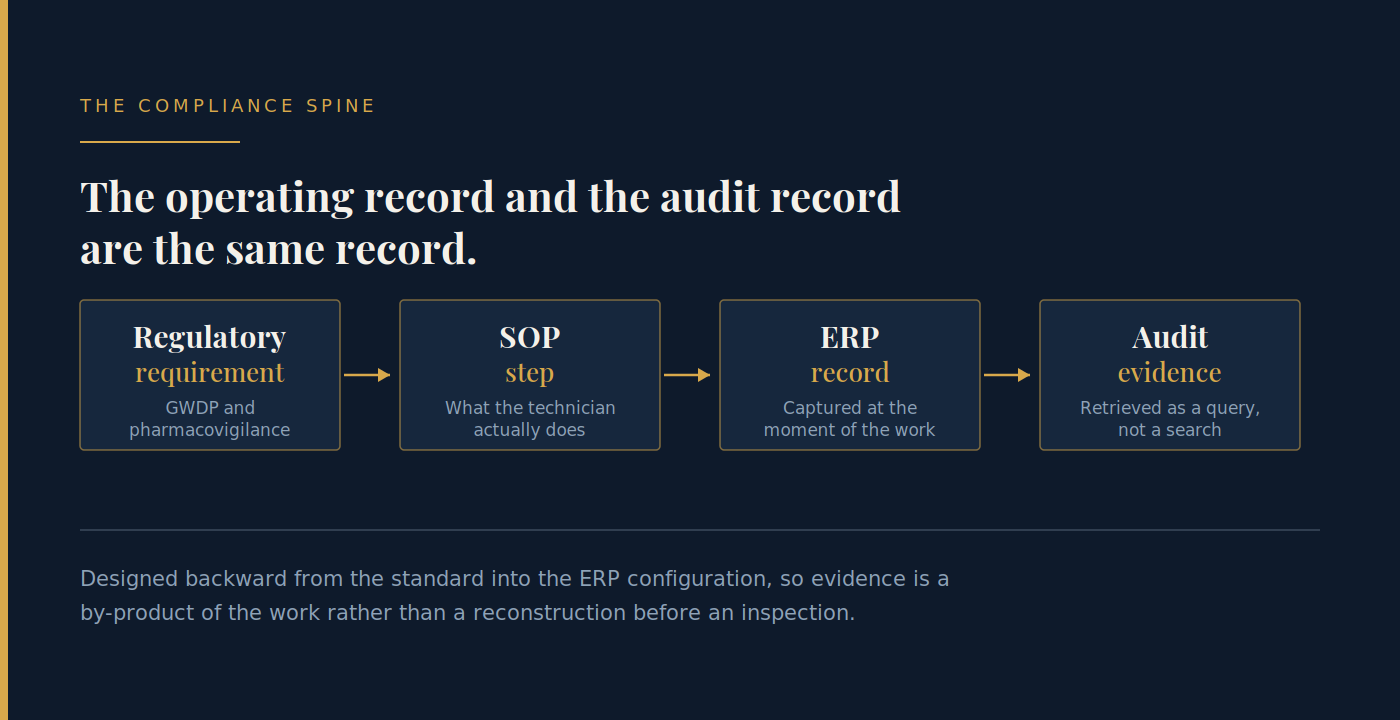
The principle was that the way the business runs and the way the business proves it runs correctly should be the same activity. If a technician follows the SOP, the ERP should already be capturing the evidence that the SOP was followed. If an auditor asks for traceability on a lot, the answer should be a query rather than a search. Compliance stops being a cost center at the point where the operating record and the audit record are the same record.
That meant working backward from Good Warehousing and Distribution Practices requirements into the ERP configuration and the process design, rather than building an operation first and documenting it afterward.
What I built
The ERP. A full Odoo implementation covering inventory, purchasing, sales, and finance, configured for regulated product handling (lot and batch tracking, expiry control, and the traceability chain from receipt through storage to dispatch, kept as an append-only audit trail rather than an editable record).
The quality system. A quality manual and the SOP set beneath it covering receipt, storage, handling, picking, dispatch, returns, recalls, temperature and warehouse conditions, and the training and record-keeping obligations that attach to each. Written to be followed by the people actually doing the work, which is the difference between a quality system and a binder.
The regulatory function. Regulatory affairs run as an ongoing operation rather than as a scramble before an inspection: product registrations maintained, documentation current, and audit readiness treated as a standing condition of the business.
The pharmacovigilance system. Post-market safety surveillance built as its own function: adverse event intake, case processing, reporting obligations and their timelines, and the safety documentation that has to stand up to an inspector. Warehousing governs how product is handled. Pharmacovigilance governs what happens after it reaches a patient, and a distributor that carries pharmaceutical product owns both.
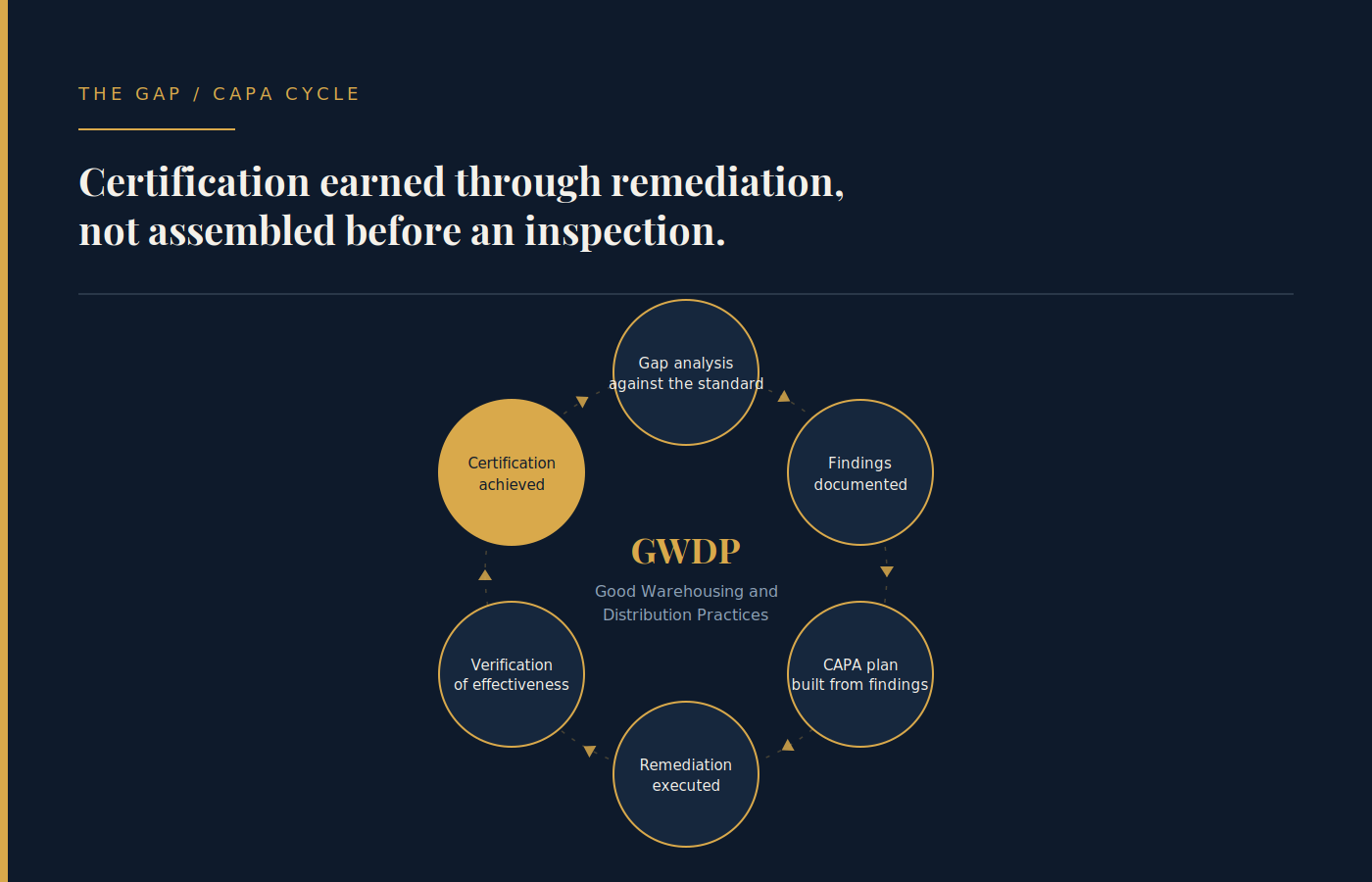
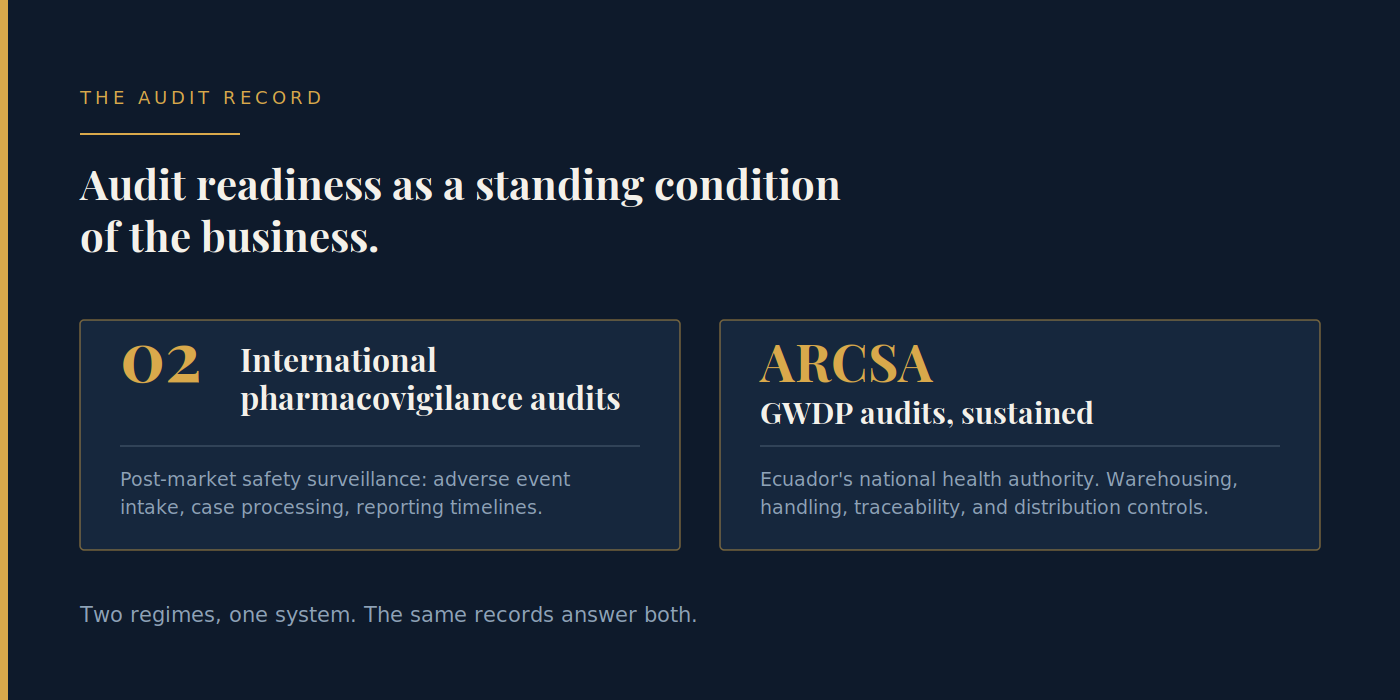
The certification and the audit record. GDP (GWDP, Good Warehousing and Distribution Practices) certification achieved through a formal gap analysis and CAPA cycle. I ran the gap assessment against the standard, built the corrective and preventive action plan from what it found, executed the remediation, and carried the business through certification. Since then the system has been inspected repeatedly rather than once: multiple GDP (GWDP) audits by ARCSA, Ecuador's national health authority, and two international pharmacovigilance audits, all passed.
The commercial operation on top of it. Distributor networks, product launches, and full P&L ownership, running on the infrastructure rather than around it.
The result
A regulated business that runs as one system. The ERP is in production and it is the operating record. The quality manual describes what actually happens on the floor. The certification was earned through a documented remediation cycle rather than assembled for an inspection. And the commercial operation runs on top of that foundation instead of improvising alongside it.
The evidence is the inspection history. Multiple ARCSA GDP (GWDP) audits and two international pharmacovigilance and technovigilance audits, passed across two separate regulatory regimes, on the same underlying records. Passing once can be preparation. Passing repeatedly, under different standards, is a system.
The through-line: I do not advise on regulated operations, I build them. This is the case that shows the whole board at once, because a regulated distribution business is where operations, quality, regulatory, and revenue stop being separate departments and become one machine that either holds together or does not.